How to judge a pre-owned luxury bag price using the boutique price
A pre-owned asking price means little on its own. Set against the price of the same bag new in the boutique, it starts to say something: how much you save, how that saving compares with other listings, and whether the price has kept up with the brand’s own rises. This guide sets out the method we use on Luxe Charts, step by step, so you can apply it to any listing you come across.
1. Pin down the exact bag
A boutique price belongs to one product: one model, one size, one material, one colour, one product code. The same model in another material can have another price, which is why each price on our model pages is tied to the full product code (Method). Before any comparison, make sure the listing and the boutique price describe the same thing.
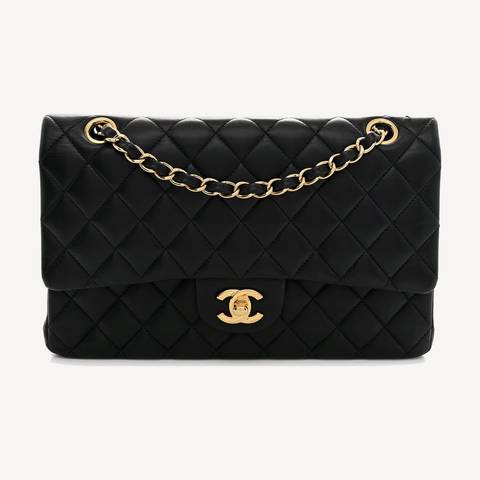
Start with the size. Size names are not always the same from one seller to another, or from the brand to the seller, so ask for measurements taken with a ruler and compare them with the official ones. The Chanel Classic Flap Medium, for example, measures 25.5 × 15.5 × 6.5 cm, and each model page shows the bag drawn at scale next to a bank card.
Then the material and the version. The boutique Classic Flap Medium today is black lambskin with gold-tone metal, reference A01112 B25747 94305, and older ones used A01112 Y01295 94305. Many bags have changed over the years, and the era can show in the details: on the Gucci Jackie, a piston lock marks the original and the Jackie 1961, a buckle the version Tom Ford introduced in 1999 (Harper’s Bazaar Malaysia); older Louis Vuitton Almas have a longer shape and a smooth base without feet, newer ones are rounder with feet (Fashionphile); on the Celine Ava, a zip marks the Ava and a magnetic flap with the Triomphe emblem the later Ava Triomphe (24S; V Magazine). When the listing is an older version, today’s boutique price is a reference for the line, not the exact price of that bag new.
2. Find today’s boutique price for your country
Use the price the brand publishes today on its own website, not one quoted in an old article or in the listing itself. On Luxe Charts, the large number at the top of each model page is that price, with the date of our most recent check.
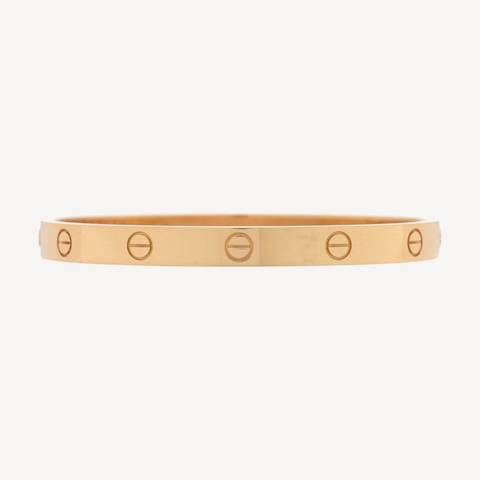
For most bag brands the price is the same across the euro area: Chanel, for instance, publishes the same price for the Classic Flap Medium, €10,500, in 11 euro area countries. Jewellery houses often set a price per country. The Cartier Love bracelet in yellow gold costs €7,950 in Luxembourg and €8,650 in Greece, so the benchmark depends on where you would otherwise buy it. Our pages list every country we check.
3. Read how the boutique price has moved
The history tells you which boutique price a seller may have in mind. The Classic Flap Medium cost €6,050 in September 2020 and costs €10,500 today. A listing that looked expensive against the old price may look different against the new one, and the reverse is true for a model whose boutique price has barely moved.
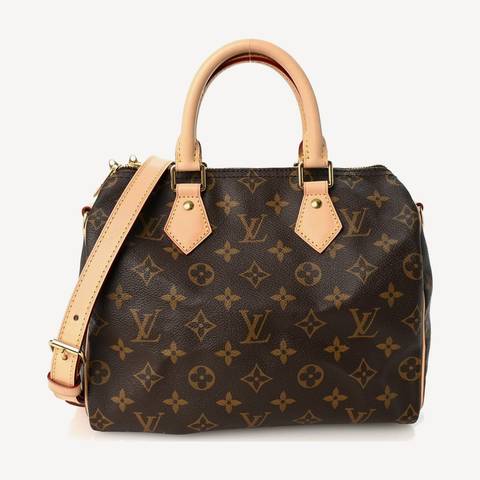
Two things to watch on the chart. First, a percentage depends on its starting point: the Louis Vuitton Speedy Bandoulière 25 is up 76% since 2014 and 56% since 2020, and both figures are right. Second, the price line is a staircase that holds until the next check shows a different price, and when several months pass between two checks the line turns lighter: we did not check the price in that stretch and we never fill it with an estimate (Method). The table “All price changes” under each chart lists every price we have seen, with its date and source.
4. Work out the delivered price of the listing
The listed price is rarely what you pay. Add the buyer’s fee the seller charges, then the shipping to your country: the result is what we call the delivered price (Method). If the item ships from outside your customs area, add any import charges you would pay on delivery too. That total is the figure worth comparing with the boutique price or with another listing. Two listings with the same headline price can end up at different totals once fees and shipping are in.
Remember also what the figure is: an asking price, the price a seller asks. We do not know what an item finally sells for, which is why we never call an asking price a “value”.
5. Put the delivered price against the boutique price
Divide the delivered price by today’s boutique price for the same model and size. The result, as a percentage, is the share of the new price the listing asks for. It is the simplest way to compare listings of the same bag across sellers and countries, and to see the saving in proportion.
The share has no fixed “right” level: it depends on the model, the size, the material and the condition. That is why the next step matters.
6. Compare with other listings of the same bag
A share of the boutique price becomes meaningful next to other listings of the same model in the same size. On a model page that shows listings, we take the delivered prices of the comparable listings, find their middle value, and call the range from 90% to 110% of it the typical price. A listing below that range is labelled “under typical”, one inside it “in line with typical”, one above it “over typical”. We give that verdict only when there are at least 8 comparable listings live at the time; with fewer, the page shows them from the lowest price without a label. Where there is a verdict, the page also says where the typical price sits against the boutique price (Method).
7. Adjust for condition and completeness
Condition is one reason two listings of the same bag can fairly ask different prices. Ask for close photos of the corners, the hardware, the surface of the leather and the inside, and for the condition grade in the seller’s own words. Check that every removable part is there: the Prada Re-Edition 2005, for example, has a removable chain handle, a detachable woven strap and a removable zipped pouch (Prada), and a listing without one of them is not the bag shown on the model page.
8. Check who stands behind the item
None of these checks proves that a bag is genuine, and Luxe Charts does not authenticate anything. Buy from a seller that says who authenticates and what happens if an item is not authentic. Each model page lists the checks that matter most for that bag, from measurements to materials, with their sources.
Where to start
Find the model on our bags or jewellery pages, or browse by brand. To see how boutique prices have moved across the bags we follow, read do luxury bags hold their value?, and for a closer look at one line, the Chanel Classic Flap size guide.